
Robot projects that reach production and stay there
Bring your robot. Build physical AI with us.
We build the Android of robotics. Physical AI developers shouldn't have to touch the real-time OS, EtherCAT, drives, kinematics, calibration or low-level control. That's the layer we own: below the application, above the chip. Install PLEM on a single Jetson and AI inference and 1 kHz real-time control run together on the same board.
What we sell is that controller, Jetson plus PLEM, and the license. Forward deployed engineering and system integration are how we put it on your robot and your floor, so you build your own robots on our stack.
Three days, on your own hardware.
On average three days from first connection to your robot running on our stack. Sometimes hours. You keep the numbers either way.
Measure
We connect to your robot and find where the time goes: kernel, threads, bus, drives.
BaselineYour numbersTiming baseline with raw logsInstall
PLEM goes on your Jetson: real-time setup, CPU isolation, drivers, tuning.
1 kHz loop runningOn your hardwareA robot that holds its cycleRun
Your policy or program drives the robot through PLEM, measured before and after.
Before / afterGo / no-goReport, integration code in your repo, license quoteMost robot projects stall between the demo and the second shift.
The model is fine. The robot is fine. What breaks is the handoff between them, and nobody on the project owns it.
The policy works in the lab and stutters on the customer's arm.
Your model decides 10 to 30 times a second. The motors need a steady command 1,000 times a second. When the AI and the motion share one computer, the handoff drifts and the arm shakes.
The customer wants an AI cell. The PLC can't hold it.
One vision-guided or high-speed segment is beyond the standard cell. Without someone who can engineer that one segment, the quote never goes out.
The station still limits shipments, and nobody has measured why.
The robot waits on the PLC, stops for a misfeed, reworks a part. Each loss is small. Together they set your output per shift, and they are invisible until someone times them.
What late commands do to a real path.
A robotics company in the San Francisco Bay Area had a 7-axis arm that lagged and chattered under streamed commands. Same arm, same computer, same paths. The only change was how commands were timed.
- Arm
- Commercial 7-axis arm, unmodified, on site in California
- Host
- Jetson AGX Orin with PREEMPT_RT, one isolated CPU (max 5 µs wake-up)
- What changed
- Joint streaming at 250 Hz, feed-forward on the measured loop delay (median 6.54 ms over 14 sine sweeps), S-curve shaping
- Against the arm's built-in planner
- 1.57 s behind plan → on time; 30 runs, zero controller errors
- Result
- −77% path error on both test paths
We did not build this arm. That is the point: the gain came from our real-time layer, not from new hardware.
One stack. Three ways in.
Each door starts with a fixed-scope step that gives you your own numbers. You decide the next step with data in hand.
Ship your robot to the customer site with timing you can prove.
- Real-time audit of your Jetson: kernel, CPU isolation, thread priorities
- Action streaming, delay compensation, trajectory shaping, IK
- Drivers and ros2_control for EtherCAT, CAN-FD and RS-485 actuators
- Bring-up with your engineers; PLEM licensed per robot
The 3-day bring-up on your robot, with a before/after report.
Forward deployed engineering →Say yes to the AI cell your customer asked for, and hit your FAT date.
- We take the one segment your PLC cannot hold and leave the rest on your standard
- Bridges to the controllers you already sell: Yaskawa, KUKA, EtherCAT drives, ROS 2
- The cell is simulated before steel is cut
- Subcontracted under your name if you prefer
We turn your line into physical AI.
- We time the station: waiting, stops, rework
- We simulate the cell you would buy
- You get a phased plan with a cost and payback band
- We build it with your integrator, on your robots and PLC
Measured, not claimed.
Outside labs, peer review and our own published test logs.
LTA LR500172603E
12 axes at 1 kHz · cycle jitter ±4.1 µs · Mar 2026
KOTCA KST-25-236
Control-loop latency and periodicity · Oct 2025
FCC Part 15B · ICES-003
W-RC controller · Class A · ICRT-TR-E262036-0A · E262037-0A · Jul 2026
ISO 9283 accuracy, KTL
Pose and distance, 40 cycles per clause at 108% rated load · run 2026-11-05
Also: registered patents KR 10-2729148 and KR 10-2717166 · U.S. patent pending · Robotics and Autonomous Systems (2026), DOI 10.1016/j.robot.2026.105763 · NVIDIA Inception Grand Challenge 2026 Top 10.
Running on production floors, not only in our lab.
Each case names the equipment involved, so you can match it to your own floor.
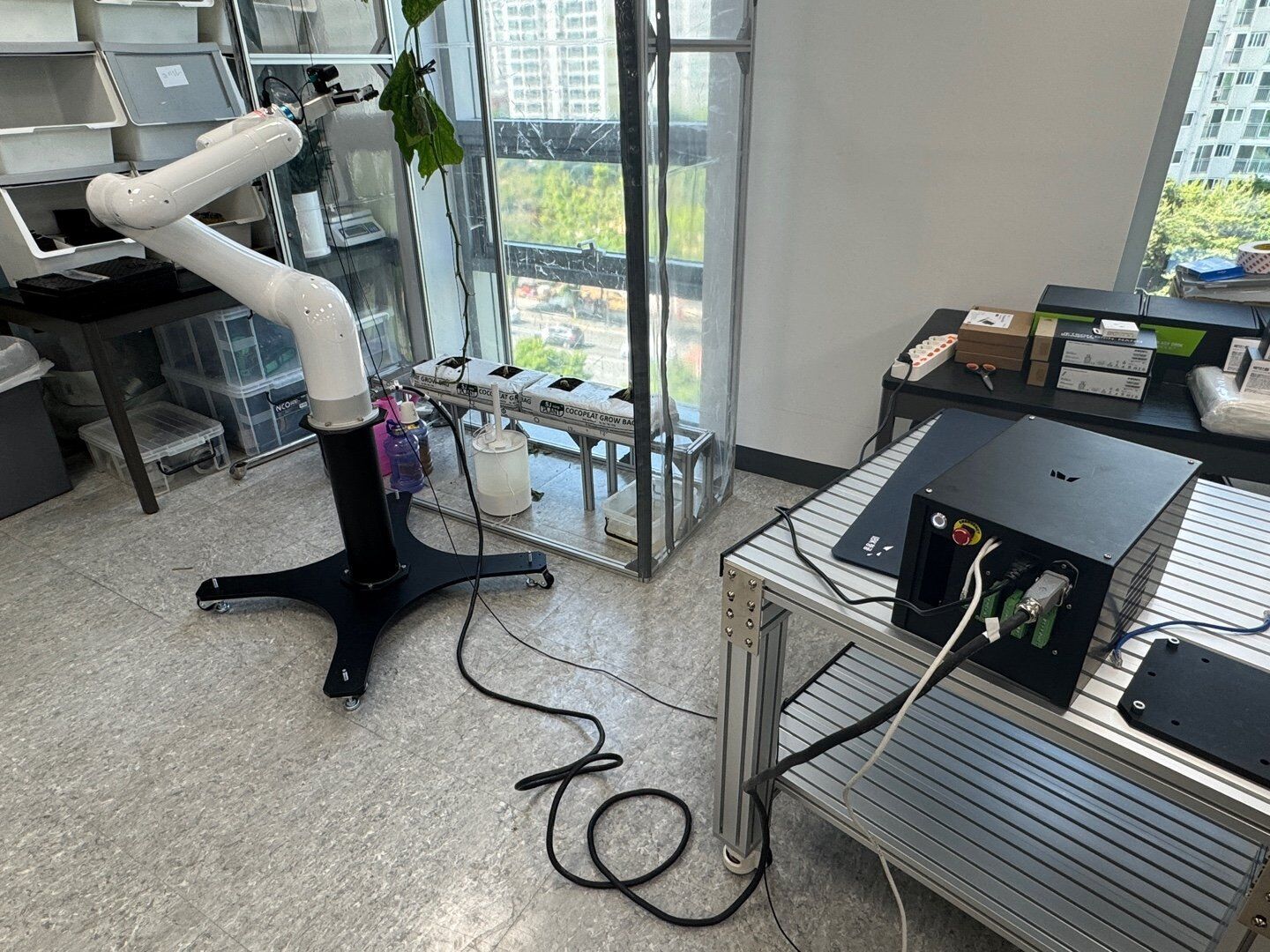
W-RC licensed to build and run their own robot systems
A Michigan automotive parts company licensed our robot control software to develop and operate its own robots, with remote support from our engineers.
| Scope | Perpetual W-RC license · remote support |
| Since | 2026 |
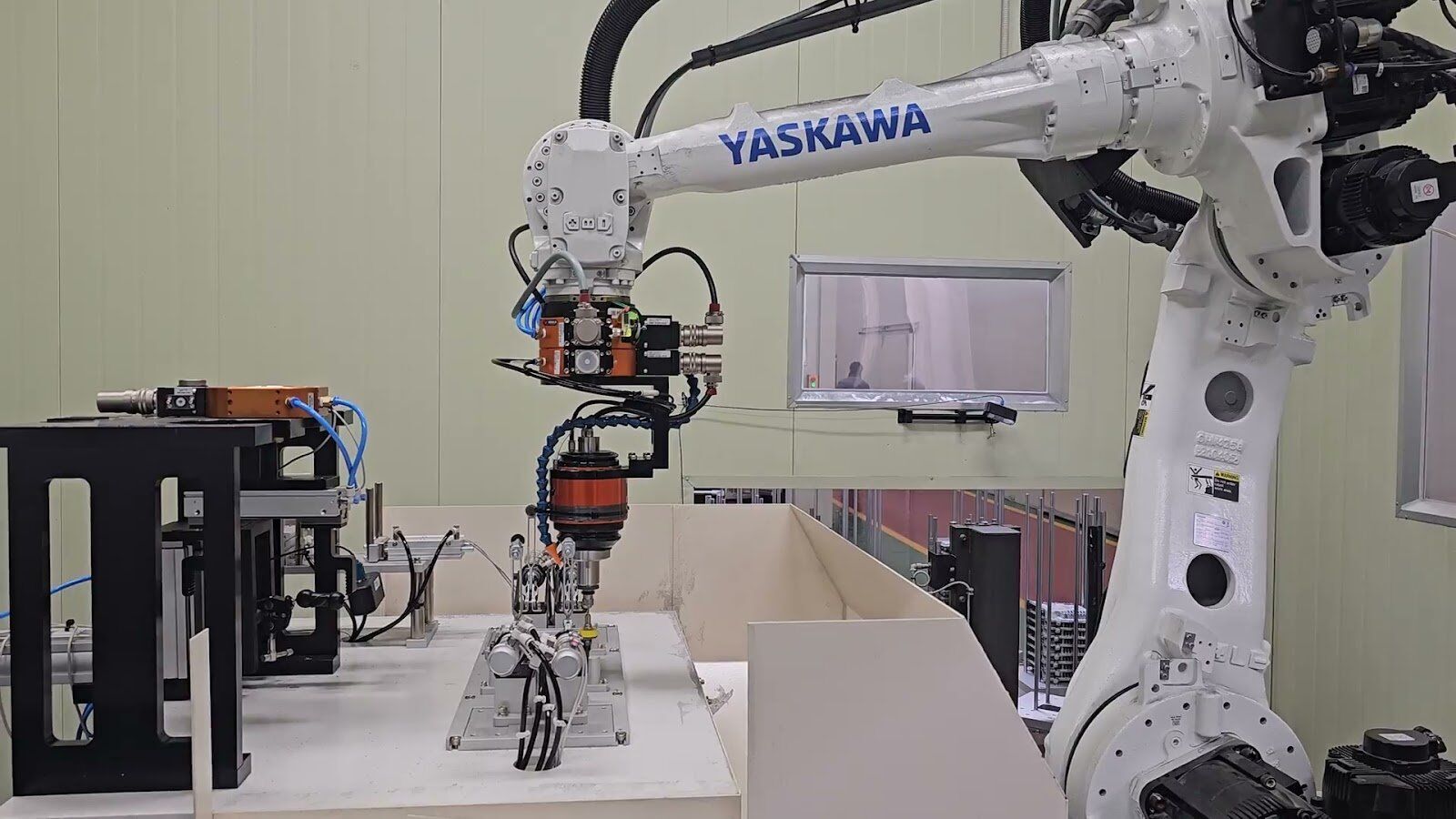
Three years of continuous work on one machining line
A deburring cell planned in simulation and run on the controller the customer already owned, plus jigs, grippers, feeders and process data.
| Equipment | Yaskawa DX200 (existing) |
| Since | 2024 · repeat orders every year |
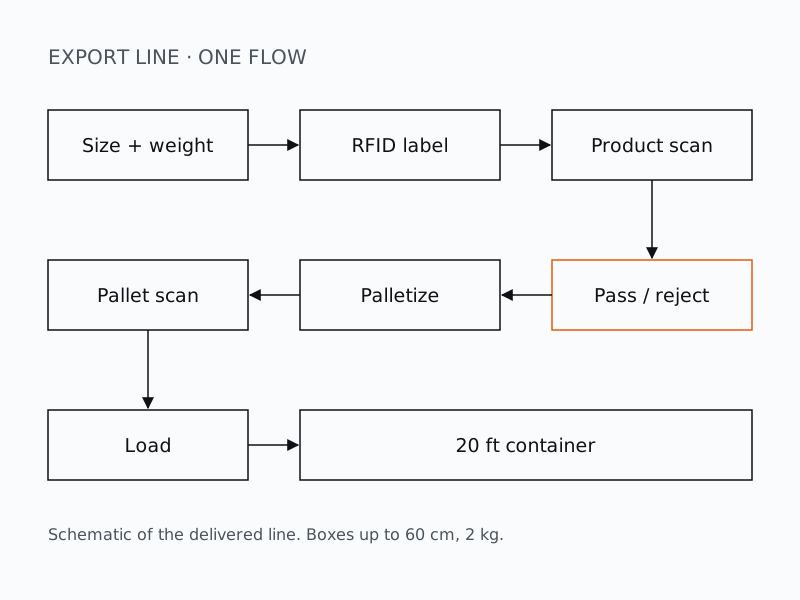
An export line from scan to container
Dimension and weight check, RFID labelling, scan gates, diverting, palletizing and container loading in one flow.
| Scope | Design, build, delivery |
| Delivered | 2026 · customer performance certificate |
One Jetson runs the AI and the 1 kHz control loop.
The model decides. PLEM moves the motors 1,000 times a second on the same board, from the real-time OS and EtherCAT down to the drives. It drives your arms directly, or sits next to the controller you already own.
10–30 Hz
→ 1 kHz
1 kHz
µs sync
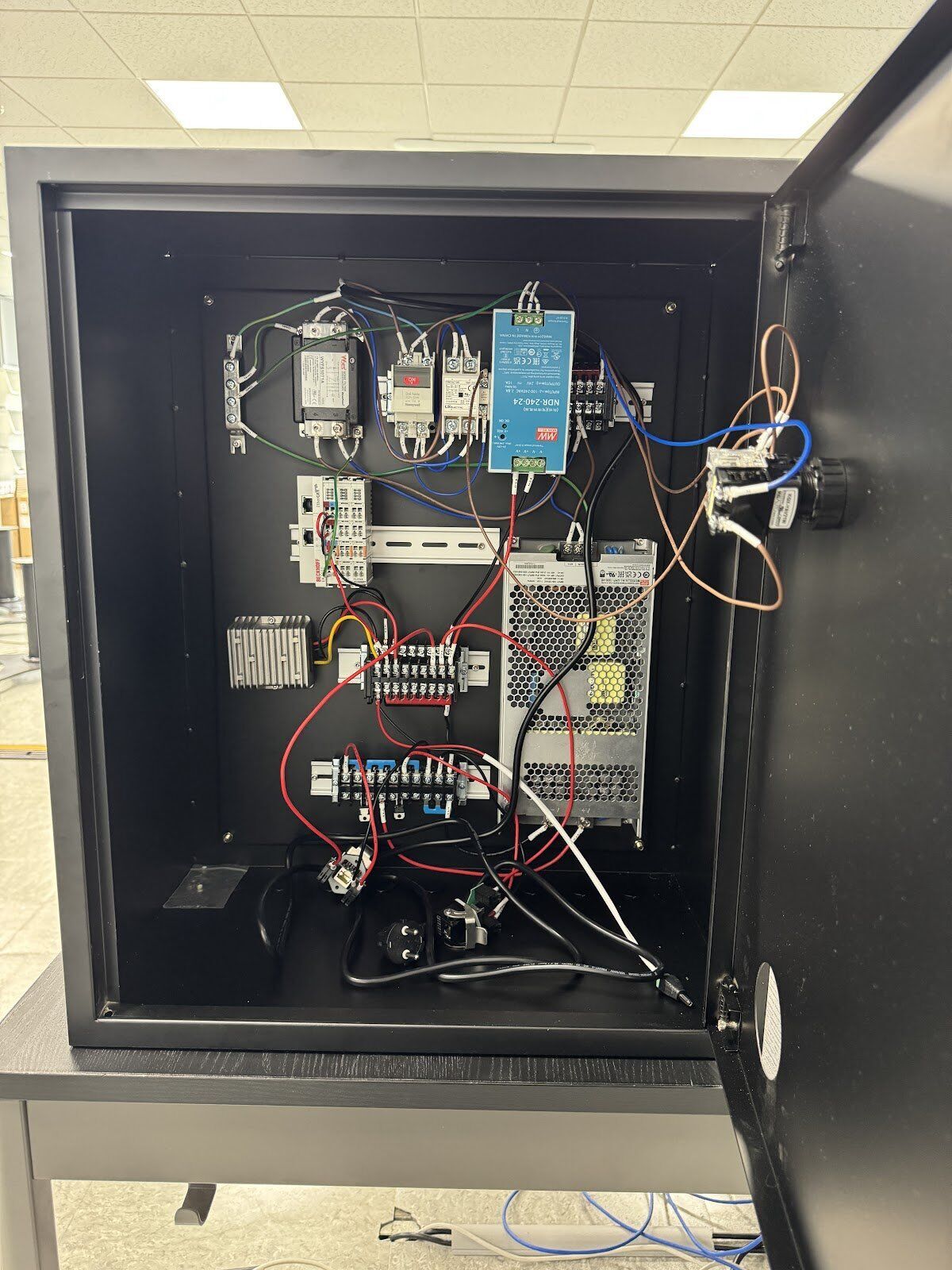
Measure first. Then build. Then keep improving.
Each step ends with something you can hold and a written go / no-go. You can stop after any of them.
Baseline
We measure your robot, cell or station: timing, cycle, stops. Remote first.
Decide with dataGo / no-goBaseline report with your own numbersDesign & twin
Layout, bill of materials, control architecture, the cell in simulation.
Design reviewFixed quoteDesign package and fixed pricePilot
One cell on your floor or on our bench, against pass criteria agreed in writing.
Pass criteria metGo / no-goBefore / after measurementProduction
Commissioning, acceptance test, operator training.
Acceptance testSigned offAcceptance report, handover documentsImprove
Support terms written into the contract. Retuning when parts, products or volumes change.
Per contractPeriodic measurement against the baselineMost engineering runs remotely. In the U.S., on-site installation, commissioning and service are performed by our engineers under the equipment purchase contract.
Built to fit what you already run.
The answers to the questions buyers ask us before the first call.
Your equipment stays.
Yaskawa through MotoROS2, collaborative 7-axis arms through their streaming APIs, KUKA, EtherCAT CiA 402 drives, ROS 2. We add only what is missing.
You approve every step against numbers.
Pass criteria are written before work starts, and each step is measured against them.
Fixed scope, priced before we start.
No open-ended hours. If the baseline says it is not worth automating, we tell you.
Your integrator keeps the customer.
We work as the engineering subcontractor, under your name if you want.
Your models, data and code stay yours.
We work in your repository. PLEM, the real-time layer, is WIM technology licensed per robot, with updates included.
Third-party tested.
Control-loop timing, 12-axis jitter and EMC are tested by outside labs, and every report is listed with its number. Safety functions run on a safety-rated controller.
Nobody should have to think about control to build physical AI.
We started as an AI team. The moment we tried to put our models on a real robot, we hit a wall that had nothing to do with AI: real-time kernels, EtherCAT, drives, kinematics, calibration. Nobody sold that layer, so we built it.
That layer is PLEM, and it runs on a single Jetson. I call it the Android of robotics.
How we deliver it is closer to Palantir. The software is the product. Our engineers go forward, onto your robot and your floor, and stay until it runs. Then you build the next one yourself, on our stack.
If your robot works in the demo and shakes at the customer site, send me the log.
WIM Robotics Inc. in the U.S. Engineering in Daegu, Korea.
One team. Pacific afternoon is Korean morning, so work moves every day.
WIM Robotics Inc.
Wholly owned subsidiary, Delaware. Your point of contact in the U.S., with daily overlap on Pacific time.
Pacific afternoon = Korean morning
WIM Corp., Daegu, Korea
Engineering, test lab, controllers and boards. Founded 2021.
KST · UTC+9
Your floor
Installation, commissioning and service by our engineers under the equipment purchase contract.
Planned into scope
Recent notes from the floor.
What we measured, tested and shipped lately.
Pi0.5 on Jetson AGX Thor, 86 ms per inference · TensorRT BF16, our fine-tuned model
ISO 9283 accuracy test with KTL on our controller · 40 cycles per clause, results pending
Dual-arm handover on a humanoid upper body · planning, IK and joint limits validated on the real robot
Excellence Award, Chung Ju-yung Startup Competition, global track · Asan Nanum Foundation
Time is a control input · the 7-axis arm field test, with raw plots
EtherCAT clock drift on Jetson, 328 → 3.5 µs · one device-tree property
NVIDIA Inception Grand Challenge 2026 Top 10
FCC Part 15B and ICES-003 test reports for the W-RC controller